The military confrontation between Iran, the United States, and Israel intensified this week as the conflict spread across several countries in the Middle East, raising fears of a prolonged regional war and major disruptions to global energy markets and international security.
Iranian forces expanded their retaliation following the joint United States–Israel military strikes that killed Iran’s Supreme Leader Ayatollah Ali Khamenei.
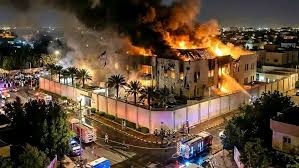
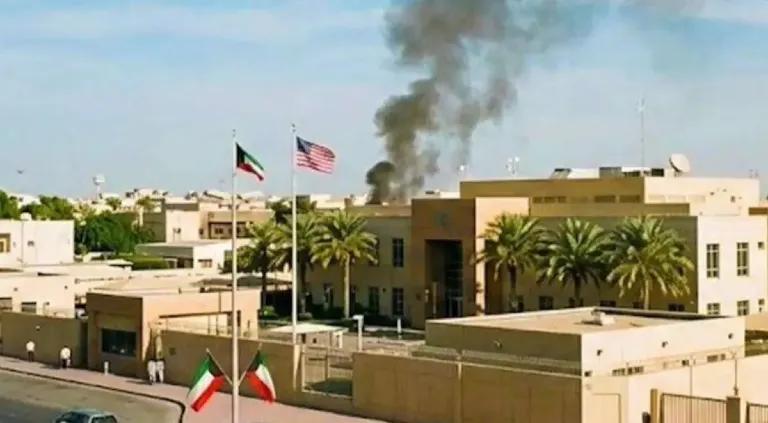
Among the latest incidents, two drones struck near the United States Embassy compound in Riyadh, Saudi Arabia, causing a limited fire and prompting heightened security measures around American diplomatic facilities across the region.
The escalation led the U.S. State Department to order the evacuation of non-essential personnel and family members from several countries where American forces maintain a presence.
Evacuations were initiated in Kuwait, Bahrain, Iraq, Qatar, Jordan, and the United Arab Emirates, while American citizens were also advised to leave multiple countries across the Middle East as military activity continued.
President Donald Trump acknowledged that the conflict could continue for several weeks, stating that current operations might last between four and five weeks but that the United States was prepared to continue longer if necessary.
Trump also suggested that additional military options remained on the table, including the possible deployment of ground forces if the situation demanded it.
Israeli Prime Minister Benjamin Netanyahu defended the ongoing campaign against Iranian targets, arguing that Iran continued developing underground facilities tied to its nuclear program.
Israel and the United States have launched a series of airstrikes targeting military infrastructure and nuclear-related sites, including Iran’s Natanz nuclear enrichment facility.
The International Atomic Energy Agency (IAEA) confirmed that the Natanz site sustained damage during the strikes, though officials reported no immediate radiological risks to surrounding areas.
According to figures released by the Iranian Red Crescent Society, at least 787 people have been killed in Iran since the beginning of the air campaign.
In Israel, Iranian missile attacks have killed 11 people, while Israeli strikes in Lebanon have resulted in 52 deaths, according to local reports.
The U.S. military, through U.S. Central Command (CENTCOM), confirmed that six American service members have died during Iranian retaliatory attacks across the region.
Three of those fatalities occurred in the United Arab Emirates, while additional casualties were reported in Kuwait and Bahrain following missile and drone strikes targeting American military positions.
The conflict has also expanded to Lebanon after the Iranian-backed militant group Hezbollah launched missiles toward Israeli territory.
In response, the Israeli military deployed additional troops into southern Lebanon, targeting what it described as Hezbollah command centers and weapons storage facilities near the border.
Senior Hezbollah official Mohamoud Komati stated that the group now sees armed confrontation with Israel as unavoidable following the recent attacks.
Beyond the battlefield, the war is beginning to affect global infrastructure and energy markets.
Iranian strikes have targeted energy facilities in Qatar and Saudi Arabia, while ships traveling near the Strait of Hormuz have also come under attack.
The narrow waterway handles roughly one-fifth of the world’s oil supply, and the growing instability has pushed global oil and natural gas prices higher.
Iranian Revolutionary Guard adviser Brigadier General Ebrahim Jabbari warned that the Strait of Hormuz could effectively be closed, stating that any vessels attempting to cross could face military action.
Technology infrastructure has also been affected. Iranian drones targeted two Amazon data centers in the United Arab Emirates and another facility near Bahrain, causing operational disruptions.
Officials in the region have condemned the attacks. Majed Al Ansari, spokesperson for the Qatari Foreign Ministry, stated that Iranian strikes on Qatar would not go unanswered and emphasized that the country was coordinating with international partners to ensure regional security.
As explosions continue to be reported in Tehran and military activity intensifies across multiple fronts, analysts warn that the conflict triggered by the death of Ayatollah Ali Khamenei could evolve into a wider regional war involving several countries across the Middle East.
With no clear diplomatic resolution currently in sight, governments around the world are closely monitoring the situation as the conflict enters one of its most volatile phases.