
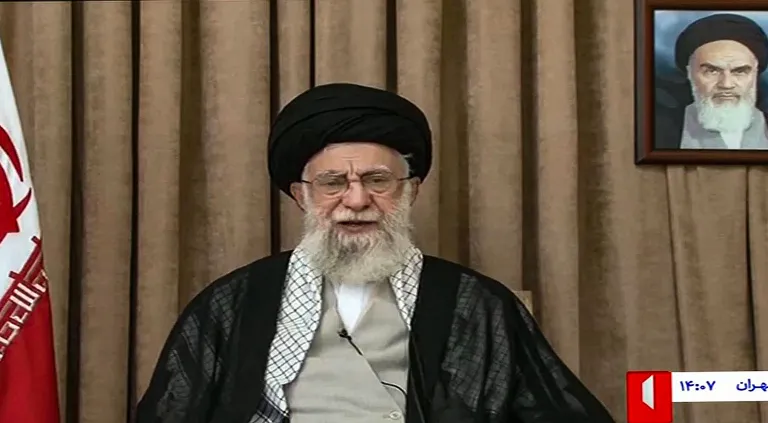
Conflicting reports emerged Sunday regarding the status of Iran’s Supreme Leader, Ayatollah Ali Khamenei, following large-scale military strikes that Iranian, Israeli, and U.S. officials have acknowledged took place in and around Tehran.
Several Iranian state-affiliated outlets, including IRIB and Mehr News, claimed that Ayatollah Ali Khamenei had “reached martyrdom” after what were described as joint U.S.-Israeli air operations targeting strategic sites in the Iranian capital.
According to those broadcasts, heavy damage was reported at a compound associated with the Supreme Leader.
Iranian authorities also announced a period of national mourning, though no independent medical confirmation was immediately released.
At the same time, Iran’s Foreign Minister — whose office had earlier stated that Khamenei was alive “as far as we know” — did not provide a follow-up briefing clarifying the situation.
The absence of a direct televised address or visual confirmation from Iranian leadership added to international uncertainty.
In Washington, President Donald Trump addressed the developments in a phone interview with CBS News, saying the military action represented “a major strategic shift” and asserting that diplomacy would now be “much easier than before.” And Khamenei, one of the most evil people in History, is dead.
When asked about future leadership in Iran, Trump said he had specific individuals in mind but declined to identify them publicly. He described the day as “a significant moment for the region.”
Israeli Prime Minister Benjamin Netanyahu has not released a full statement confirming the reports but senior Israeli officials speaking to domestic media described the strikes as a “decisive operation.”
Israeli television network N12 reported that senior government figures had been briefed on post-strike intelligence assessments.
Defense analysts caution that claims surrounding the death of a sitting head of state require verifiable evidence, especially given the scale of geopolitical consequences.
As of this writing, there has been no independent confirmation from international observers, the United Nations, or neutral diplomatic missions in Tehran.
Former intelligence officials in Israel, including individuals previously associated with Mossad, have warned that if Khamenei were confirmed dead.
Iran could face a rapid internal power struggle involving the Islamic Revolutionary Guard Corps (IRGC) and clerical leadership bodies such as the Assembly of Experts.
Some U.S. intelligence assessments in past years have suggested that a hardline IRGC consolidation of authority would be possible in a sudden leadership vacuum.
Ayatollah Ali Khamenei, 86, has led Iran since 1989 following the death of Ayatollah Ruhollah Khomeini.
Over more than three decades, he has overseen Iran’s regional strategy, nuclear policy posture, and its relationships with proxy forces across the Middle East.
His leadership has long been a central factor in tensions between Tehran, Washington, and Jerusalem.
International markets and regional governments are closely monitoring developments.
No formal succession announcement has been issued, and Iran’s constitutional process requires the Assembly of Experts to appoint a new Supreme Leader if the position becomes vacant.
Until official medical documentation or a public funeral procession is broadcast, global officials remain cautious about treating the reports as confirmed.
Diplomatic channels in Europe and the Gulf states have urged restraint while awaiting verified information.
The situation remains fluid, with military alerts reportedly elevated across parts of the region


